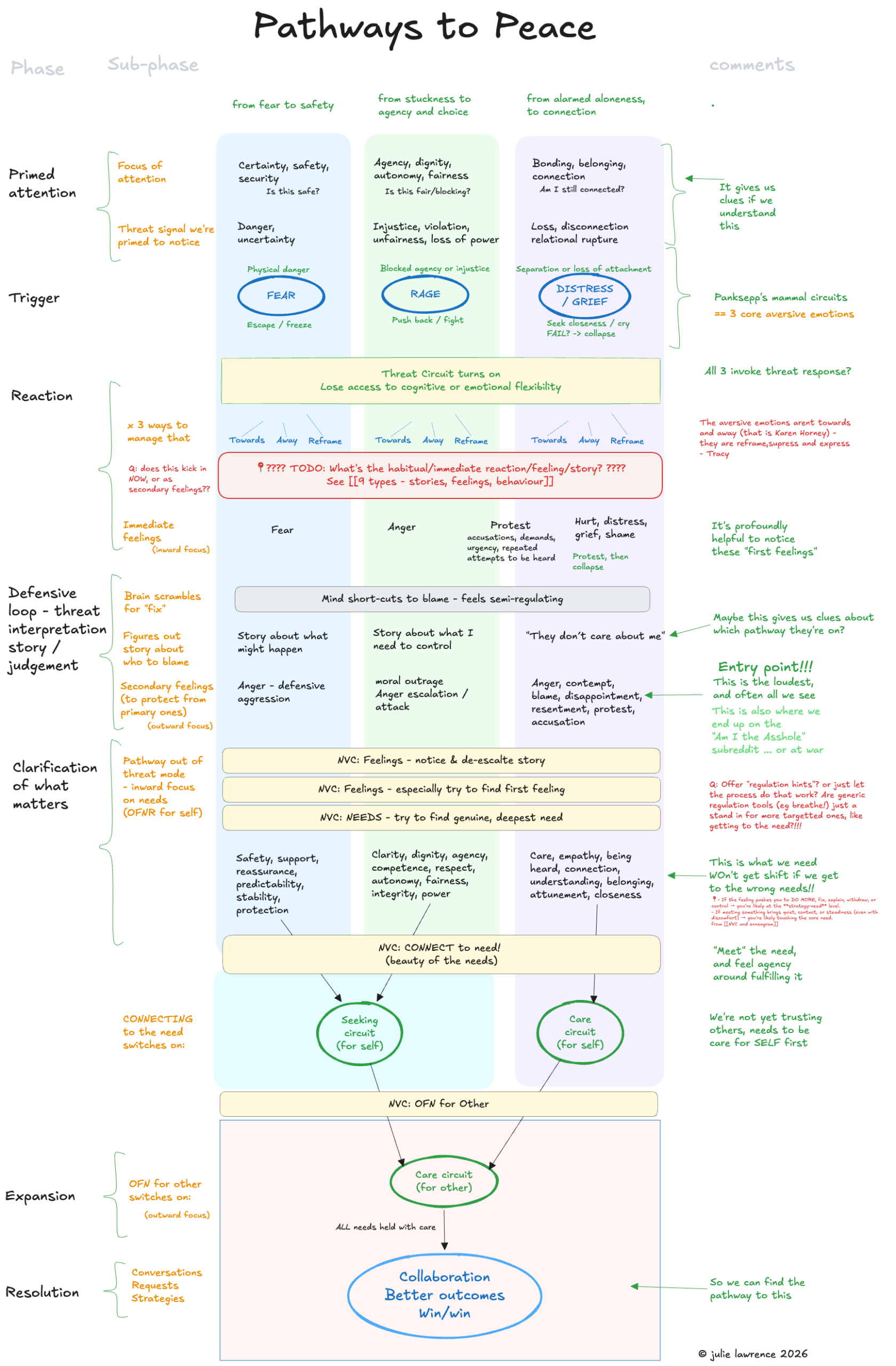
Maps NVC with Jaak Panksepp’s emotions taxonomy, and Sarah Peyton’s work on the Seeking circuit, and Tracy Baker-Lawrence’s work on enneagram pathways.
I’ve come to understand conflict as something that begins when one of the three core aversive emotions common to all mammals is triggered: fear, anger, or distress. In Jaak Panksepp’s affective neuroscience research these correspond to the FEAR, RAGE, and PANIC/GRIEF systems, and we each tend to be hard-wired to lean towards one of those more than the others (see Affective Neuroscience Theory and Personality: An Update).
When one of these systems activates, it switches on what we might call the brain’s threat circuit. In this state, the brain reduces cognitive and emotional flexibility so it can focus on survival. Because speed matters more than accuracy here, the mind tends to create quick explanations for what’s happening. These explanations almost always involve figuring out who is to blame and how to stop them. In other words, the brain quickly generates what Marshall Rosenberg would call a tragic strategy.
Nonviolent Communication is essentially a process for helping people move out of this threat state and into two other brain systems that support much more flexible thinking: the SEEKING circuit (curiosity about what I want or need) and the CARE circuit (care for myself and for others).
Sometimes people get stuck along the way. One common reason is that they miss the first feeling that activated the threat response. Instead, they focus only on the secondary, defensive feelings that appear afterward. When that happens, they often identify the wrong need underneath the situation, and nothing really lands — they never experience the “shift” that NVC practitioners often talk about.
How someone responds to that first feeling often depends on their preferred regulation strategy. Broadly speaking, there are three ways humans tend to regulate emotions:
- expressing the feeling and moving toward it
- suppressing the feeling and moving away from it
- reframing the feeling cognitively
(These three responses to the three core aversive emotions give us the 9 Enneagram types.)
For example, I might initially feel anger when something crosses a boundary. But instead of staying connected to that anger, my nervous system tries to feel safer by reframing the situation cognitively. I disconnect from the anger and mainly notice a vague discomfort instead. Then I may rationalise that discomfort away through numbness or resignation.
If I then look for the need underneath that state, I might conclude that what I need is peace. But that may not actually be the original need at all. The anger might have been signalling something closer to agency or self-respect — needs associated with the anger/agency triad.
If I keep trying to meet the need for peace, it never fully resolves the situation, because it wasn’t the real signal in the first place. When the original need is recognised, however, the system can often settle much more deeply.
Furthermore, it’s not enough to just NAME a need, that can be an intellectual process. To really shift our state, we need to truly connect to the need, and what it means to us. Susan Skye did wonderful work towards this understanding, that was later called “beauty of the needs”.
This app offers tools to help you look beneath the surface reactions and reconnect with the deeper need that may have been missed. When that underlying need becomes clearer, it’s much easier to find strategies that genuinely move the situation forward rather than repeating the same old patterns.
React → Get curious → Understand → Connect → Solve
Diagram is a work in progress, very early yet, just uploading for tracking.